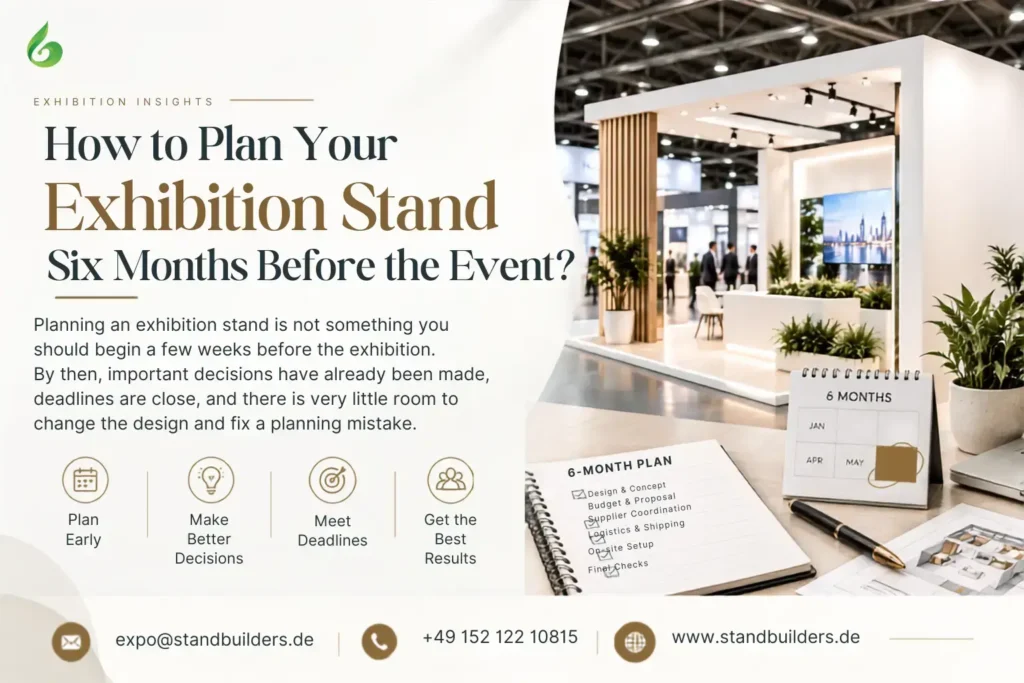
Planning an exhibition stand is not something you should begin a few weeks before the exhibition. By then, important decisions have already been made, deadlines are close, and there is very little room to change the design and fix a planning mistake. Six months gives you enough time to build the trade show booth around your actual business objectives instead of rushing to get something ready for the exhibition floor. It allows you to work through the design, branding, production, logistics, and visitor experience properly, while also giving your sales and marketing team time to prepare.
Here is how to use those six months effectively:
Six Months Before: Decide what the exhibition needs to deliver
Before discussing the design, graphics, or the size of the reception counter, the discussion should be about the reason you are exhibiting. For some companies, the priority is generating new leads; others may be launching a product, meeting existing customers, finding distributors, or building their presence in a new market. Once that is clear, it becomes much easier to make design decisions. A company looking for sales leads may need an open, approachable space with room for short conversations. A business expecting important clients may need proper meeting areas where they can host one-on-one meetings with existing clients to strengthen their relationships and have sales discussions. If a new product is the main attraction of the brand exhibiting at the trade show, then the stand may need a dedicated demonstration area, with proper lighting highlighting that particular product to start the conversation around the newly launched item. Set a few realistic targets that you want to achieve at the trade show; knowing how many qualified leads, meetings, or enquiries you want from the event gives the team something concrete to work towards to achieve the exhibition stand. You need to discuss all these key factors with your exhibition stand contractors to prepare for the big event.
Five Months Before: Study the event before designing the stand
Your exhibition stand should be an extension of your brand; it should not just stand in isolation. Talk with your exhibition stand designer about how it sits within a particular exhibition, venue and audience. Look at the type of visitors the event attracts and the companies exhibiting alongside you. Understanding the audience will help you decide what information should be prominent and how the space should be used. The sole purpose of exhibiting at the major trade show is to gain attention, enhance visitor engagement, and generate highly qualified leads. So the location of the stand matters the most. A corner position, island stand, or a space near a major entrance can create different opportunities, while a stand surrounded on three sides will need a different approach to make it attractive. Check the organizer’s technical regulations at this stage. Height restrictions, hanging signage, rigging permission, and installation rules can all influence the design. Finding these restrictions early is far easier than changing the stand shortly before production.
Four to Five Months before: Brief your exhibition Stand Designer.
Now you can start developing the stand concept. Give your exhibition stand designer and builder a proper brief rather than simply asking for something “modern” or “eye-catching”. Share your objectives, audience, stand dimensions, product requirements, brand guidelines, and budget. Also explain how you expect visitors to use the space.
Do you need product demonstrations? How many people should be able to sit in a meeting? Do you require storage? Will your sales team need a private area for detailed discussions? These practical questions are important because a stand can look excellent in a 3D visual and still be uncomfortable or inefficient once it is built. Good exhibition stand design considers the visitor’s movement as well as the appearance of the booth.
Four Months Before: Choose the Design and keep it focused.
By this point, you should have a clear design direction. Do not try to put every product, service, and company message into the stand. Visitors are unlikely to spend several minutes reading a wall full of information while walking through a busy exhibition hall. Choose the products or services that deserve the most attention and give them enough space. Your main brand message should be easy to see from the aisle. More detailed information can be presented inside the stand through product displays, screens, brochures, or conversations with your team. This is also a good time to review the balance between design and budget. If there are expensive features that do not contribute to your exhibition objective, remove them and invest in something that will have a more useful impact.
Three Months Before: Start Working on the Content:
Once the stand design is moving towards approval, begin preparing the content that will go into it. This includes wall graphics, product descriptions, photographs, and videos. Presentations, brochures and digital material. Keep the messaging consistent. Your exhibition stands, website, social media posts, and sales presentations should all communicate the same basic story. Think carefully about what a visitor needs to know at different points. From the aisle, they need to recognize your brand and understand what you offer. Inside the booth, they can learn more about specific products or solutions. During a meeting, your sales team can go into the details. The hierarchy keeps the stand informative without making it feel overloaded.
Three Months Before: Plan How You Will Capture Leads:
Lead collection should be considered while the stand is being planned, not after it has been built. Decide what information your sales team actually needs from visitors. A name and email address may not be enough to tell you whether someone is a serious prospect or just a visitor. Depending on your business, you may want to record a visitor’s company, their roles, product interest, project requirement, or expected purchase timeline. You can use badge scanners, CRM tools, or digital tools to make this process easier.
Two Months Before: Prepare the Team:
Your exhibition staff can make or break the experience. Start by preparing them well before the event. Everyone should understand the purpose of the exhibition, the products being promoted, and what type of customers the company wants to meet. It is also worth assigning responsibilities. Someone can focus on welcoming visitors, another can handle demonstrations, and the senior team can take care of meetings. A little organization prevents the booth from becoming chaotic when visitor traffic increases at your trade show booth.
Six to Eight Weeks Before: Begin your pre-event marketing:
Do not wait until the first morning of the exhibition to tell people where you will be. Start communicating your presence several weeks in advance; use email campaigns, LinkedIn, your website, and direct communication with your existing customers. But do not simply announce your stand number; give people a reason to visit. You could promote a product launch, a live demonstration, a new opportunity to meet one of your specialists at your trade show booth. A calendar with several confirmed meetings is a much stronger starting point than hoping the right people happen to walk past your booth.
One Month Before: Confirm Production and Logistics:
At this stage, the focus should move from ideas to execution. Your exhibition stand contractors should have the approved designs and production requirements. Check that the furniture, lighting, graphics, AV equipment, product display, and other elements have all been accounted for. Confirm delivery schedules, installation dates, and venue requirements. If products or machinery are being displayed, check how they will reach the exhibition venue and whether special handling is required.
Two Weeks before: Test Everything
Do not leave the testing until the day of installation. Check presentations, videos, product demonstrations, tablets, QR codes, and any other technology being used at the stand. Make sure every QR code leads to the correct page and that those pages work properly on mobile devices. Review the final graphics for spelling, product information, and contact details. This is also the time to give the sales team the final schedule and lead process so everyone knows what will happen once the visitors start arriving.
During the Exhibition: Stay flexible:
Preparation gives you a plan, but the exhibition itself may tell you something different. Pay attention to what visitors are asking about. If a product is receiving considerably more interest than expected, make it easier to find. If visitors are struggling to understand something, adjust the explanation. Your team should also keep the stand presentable throughout the day. A clean, organized booth creates a better impression and attracts visitors to explore the products and brand.
After the exhibition: Measure what actually happened:
The final step is often overlooked by many exhibitors. Once the event is over, review the results while everything is still fresh. Look at the number of visitors, qualified leads, enquiries, and follow-up opportunities. More importantly, look at the quality of those leads and what happens afterwards. Which products attracted the most engagement? What conversations turned into meetings? Did visitors respond to the message used on the stand? Was the layout practical for your team? Use those answers when planning the next exhibition.
Conclusion:
An exhibition stand is a significant investment, so rushing the process rarely drives results. Starting six months ahead gives your team time to make considered decisions, refine the design, and prepare for the commercial side of the event. With the right preparation and exhibiting with professional and exceptional exhibition stand contractors, your stand can do more than attract attention. It can create conversation, support your sales team, and turn your exhibition traffic into business opportunities that continue long after the event has ended.
An impactful exhibition stand is not necessarily the largest one in the hall. They are the ones where design, branding, visitor experience, and sales objectives have been planned together. Partnering with an expert exhibition stand builder can make your exhibiting experience seamless and hassle-free. Stand Builders GmbH is one of the top-ranked trade show booth building companies, with 15 years of experience. With extensive years of expertise, top-notch manufacturing capabilities, and strategic planning, we deliver a visually striking, powerful, and functional exhibition stand that is executed on time. We also provide turnkey execution solutions and professional assistance throughout the process.