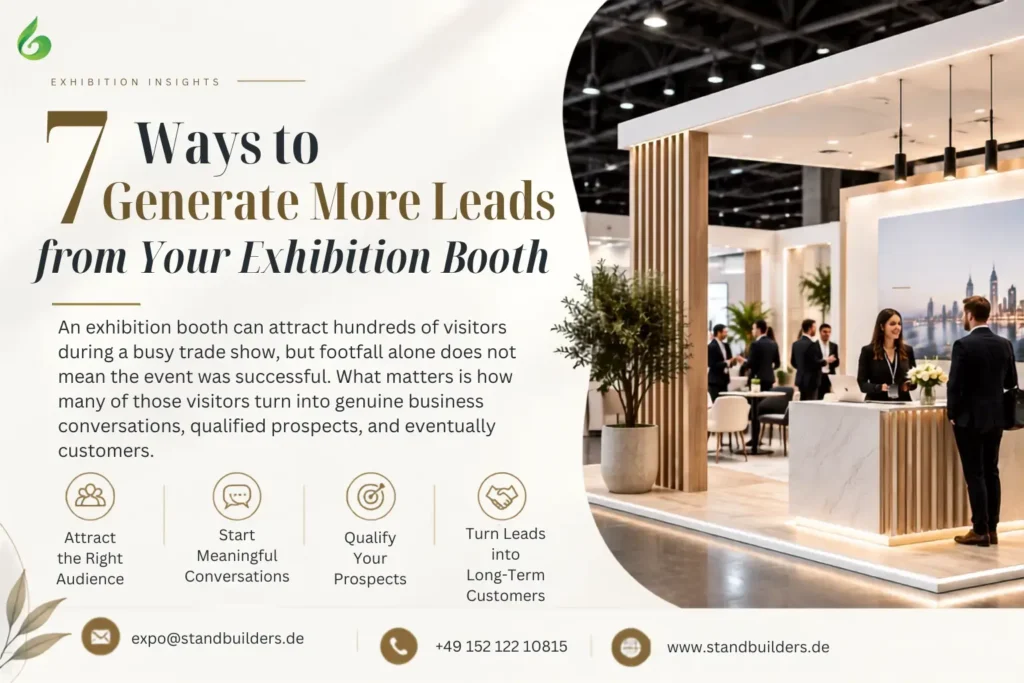
An exhibition booth can attract hundreds of visitors during a busy trade show, but footfall alone does not mean the event was successful. What matters is how many of those visitors turn into genuine business conversations, qualified prospects, and eventually customers. This is where many brands miss an opportunity. A trade show booth may look impressive from the aisle, yet the team may not have a clear way to start conversations, identify serious buyers, or follow up after the show. On the other hand, a simple but well-planned exhibition booth can generate better leads because every part of the experience is designed around the visitor and the next business conversation. If your goal is to get more value from your next exhibition, here are seven practical ways to turn your booth into a stronger lead-generation space.
Give Visitors a Reason to Stop: The first few seconds matter. Visitors walking an exhibition hall are surrounded by competing brands, displays, sales teams, and promotional messages. Most will not stop simply because a booth looks expensive. There needs to be a clear reason for them to pause. Start with a message that speaks directly to a problem your target customer is trying to solve. Instead of filling the main wall with your company history or long list of services, focus on what the visitor can gain by talking to you. For example, a technology company could lead with a message about reducing production downtime rather than simply displaying its product name. A machinery manufacturer could highlight improved output or lower operating costs. The message should make the visitor think, “This could be useful for my business”. The same principle applies to the visual design. Keep important information at eye level and make sure your main message can be understood from the aisle. Your exhibition stand design should create curiosity without forcing people to read paragraphs before they understand what you do. The objective is simple: get the right person to start a conversation.
Design the booth around the conversation, not just products: One of the easiest ways to start a conversation is by planning your exhibition stand design around your brand. The trade show booth should not be treated as a showroom. Products are displayed, graphics are installed, and screens are playing videos, but there is no clear place or process for a business conversation to happen. Your booth should have areas that naturally support different stages of visitors’ journey. There can be an open area for initial conversations, a product demonstration zone for visitors who want more information, and a quieter meeting space for serious prospects. These areas do not necessarily need to be large. Even a compact booth can be planned around these different requirements. The important thing is that visitors should not feel as though they have entered a space where they are immediately going to be given a sales pitch. Train your team to start with the visitor rather than the product; a simple question such as “What are you currently looking to improve?” can lead to a much more useful conversation than immediately explaining everything your company offers.
Use demonstrations to show the value of your products: For many B2B companies, explaining a product can take several minutes. A demonstration can often communicate the same value much faster. If your product can be demonstrated, make it a central part of the visitor experience. Instead of showing a presentation that talks about what the product can do, show it actually solving a problem. Walk visitors through a common situation and demonstrate how your product, software, or services handle it. Demonstrations also create natural opportunities for your sales team to ask questions. Once a visitor shows interest, your team can find out what they currently use, what problem they face, and whether the solution is relevant to them.
Qualify Visitors instead of collecting random contacts: More leads do not always mean high-quality customers. You should identify who is actually interested in buying or investing in the brand. It is easy to collect hundreds of business cards or scan hundreds of badges during an exhibition and then discover that very few contacts are actually useful. A better approach is to understand who is genuinely interested before adding them to your sales pipeline.
Makes Lead Capture quick and worthwhile: Even when a visitor is interested, they may not want to spend five minutes filling out a long form at your booth. Keep lead capture simple. Depending on your business, visitors could scan a QR code to request a product catalogue, book a meeting, receive technical information, or register for a demonstration. Your team can also use digital lead-capture tools to record key details during the conversation. But there is an important point here: give visitors a reason to share their information. For B2B companies, the information collected should also go beyond a name and email address whenever possible. Recording the visitors’ name, company, role, area of interest, and requirement can make the follow-up considerably more effective.
Offer Something Useful instead of another promotional giveaway: Branded merchandise can attract visitors, but it does not necessarily create a business opportunity. If lead generation is the priority, consider offering something connected to your industry and your customer’s needs. It could be a short industry report, product comparison guide, checklist, technical guide, case study, or consultation. For some businesses, a quick assessment or product recommendation can work particularly well. For example, a company selling energy solutions could offer a basic energy-efficiency assessment. A software provider could offer a short consultation to identify process gaps. This type of offer gives visitors a reason to start a conversation and position your company as someone who understands the problem and is able to address it.
Start your follow–up plan before the exhibition: Lead generation does not end when the exhibition closes. In fact, some of the most important work begins after the hall has emptied. Before the event starts, decide how leads will be handled once they are collected. Assign responsibility to a specific member of the sales team and decide how quickly different categories of leads should be collected. A visitor who has specifically requested a quotation should not receive the same follow-up as someone who simply downloaded a brochure. High-priority prospects may need a call within a day or two, while other contacts may be better suited to a longer nurturing campaign. Personalisation also matters. Mention the conversation you had with them, the product they were interested in, or the problem they discussed. This immediately makes the follow-up feel more relaxed.
Conclusion.
To exhibit at any trade show or business event, you need an exceptional exhibition stand that makes you stand out on the global platform to display your brand. Stand Builders GmbH is the perfect partner and a highly renowned exhibition stand builders, with over 15 years of experience. Our expertise is creating bespoke booth designs that are entirely tailored to your brand’s identity and attract visitors’ attention. Showcase your products and brand with our impactful and visually striking exhibition stand to generate high-value leads. Our professional team provides assistance throughout the process and handles everything. We make your entire exhibition experience seamless and smooth.